&geometry(423x99) "McMurter & Associates")
Estate Administration Tax and Capital Gains in Ontario: How Planning Ahead Can Reduce Probate Fees
The short answer: Estate Administration Tax (often called probate fees) and capital gains tax are two separate taxes that can both arise when someone dies in Ontario. Estate Administration Tax applies to assets that pass through the estate. Capital gains tax applies to the growth in value of certain assets, like real estate, and is reported on the deceased's final tax return. Thoughtful planning can reduce the impact of both.
An October 2025 Globe and Mail article profiled three siblings who, after their father's death, worked with their elderly mother, financial advisers, and other professionals to transfer roughly $6 million in family wealth before she passed away.
Their story highlights what good planning looks like: starting early, having clear legal authority, involving professionals, and keeping everyone in the family in the loop. It also raises a question many families ask: what are the tax consequences of passing wealth on?
What's the difference between Estate Administration Tax and capital gains tax?
| Estate Administration Tax (EAT) | Capital gains tax | |
|---|---|---|
| What is it? | A fee, commonly called probate fees, charged when an estate certificate is issued | Tax on the increase in value of certain assets, such as real estate and investments |
| When does it apply? | When assets pass through the estate | When an asset is sold, gifted, or treated as sold at death |
| Who pays it? | The estate | The estate, on the deceased's final tax return |
| How is it calculated? | Based on the value of the estate | Based on the gain in value |
The two are distinct, but they often arise at the same time, which is why both belong in a comprehensive estate plan.
How much is Estate Administration Tax in Ontario?
In Ontario, there is no EAT on the first $50,000 of an estate. Above that, the tax is $15 for every $1,000 of estate value (1.5%).
For example, on a $500,000 estate, the EAT would be $6,750: $0 on the first $50,000, plus $15 for each of the remaining 450 thousand-dollar increments.
How does capital gains tax work when someone dies?
When someone dies, the Canada Revenue Agency (CRA) generally treats their capital property as if it had been sold at fair market value immediately before death. This is called a "deemed disposition." Any gain is reported on the deceased's final tax return, and the estate pays the tax.
Two important points:
- Some assets are treated more gently. For example, a principal residence may be exempt from capital gains tax, and certain assets can transfer to a surviving spouse without triggering an immediate tax bill.
- Beneficiaries don't pay tax on what they inherit. Canada has no inheritance tax. Any tax is generally the estate's responsibility, and it's paid before the beneficiaries receive their share.
Can you reduce Estate Administration Tax?
You can't make EAT disappear for assets that pass through the estate, but you can reduce how much is subject to it. Steps to discuss with your lawyer include:
- Prepare a properly drafted will with an experienced estate planning lawyer. A will doesn't eliminate EAT, but it can simplify probate and reduce complications for your loved ones.
- Name beneficiaries on registered accounts. Certain accounts, such as RRSPs, RRIFs, TFSAs, and life insurance policies, allow you to name a beneficiary directly. Assets that go straight to a named beneficiary generally don't form part of the estate and aren't subject to EAT.
- Review how you hold property. Assets held jointly with right of survivorship also pass outside the estate, but joint ownership has its own legal and tax implications, so get advice first.
- Consider gifting assets during your lifetime. This is the approach the three siblings and their mother took.
What about gifting assets before death?
In the Globe and Mail story, the family chose to gift assets during their mother's lifetime rather than letting the full value pass through probate. With the right planning in place, this reduced the overall tax and probate burden that would otherwise have applied.
But gifting isn't a free pass. Before transferring assets during your lifetime, keep these in mind:
- Gifts can trigger capital gains. Giving away property such as real estate or investments can result in capital gains for the person making the gift, and these must be documented and reported.
- Document your intentions. A gift to an adult child isn't always automatically treated as a gift. Clear paperwork helps avoid disputes.
- Think about control and security. Once assets are transferred, they're no longer yours to rely on.
- Involve the right professionals. Lawyers, accountants, and financial advisers can help make sure the plan works legally and financially.
Contact
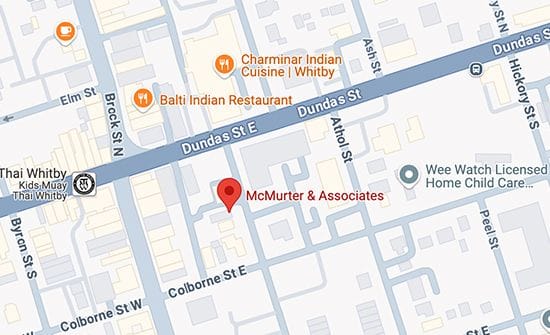
Brian McMurter is a real estate and estate planning lawyer at McMurter & Associates in Whitby, helping Durham Region, Ontario residents with estate planning and real estate law.
Contact McMurter & Associates Monday to Friday, 9 a.m. to 5 p.m. at info@mcmurter.com or call 1 800 756 7138 or 905 666 9200 to schedule a consultation.
Disclaimer: This article provides general information about Ontario law and is not a substitute for legal advice. Please speak with a lawyer about your specific circumstances before making decisions about real estate law and estate planning.
| Tags:Wills & EstatesEstate Administration Tax in Ontario | McMurter & Associates |